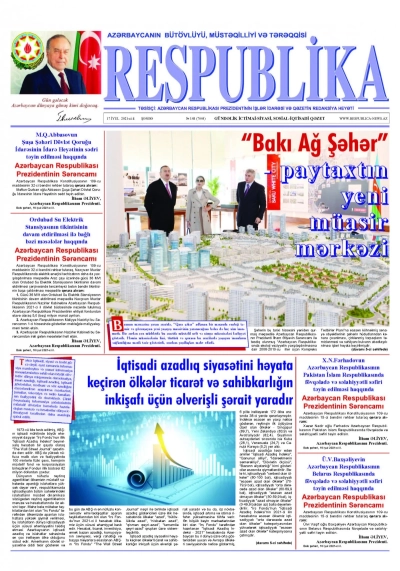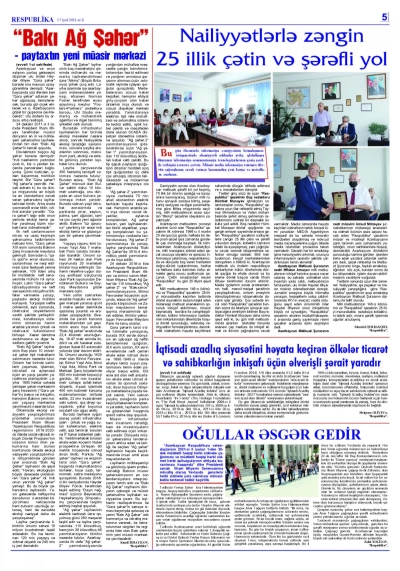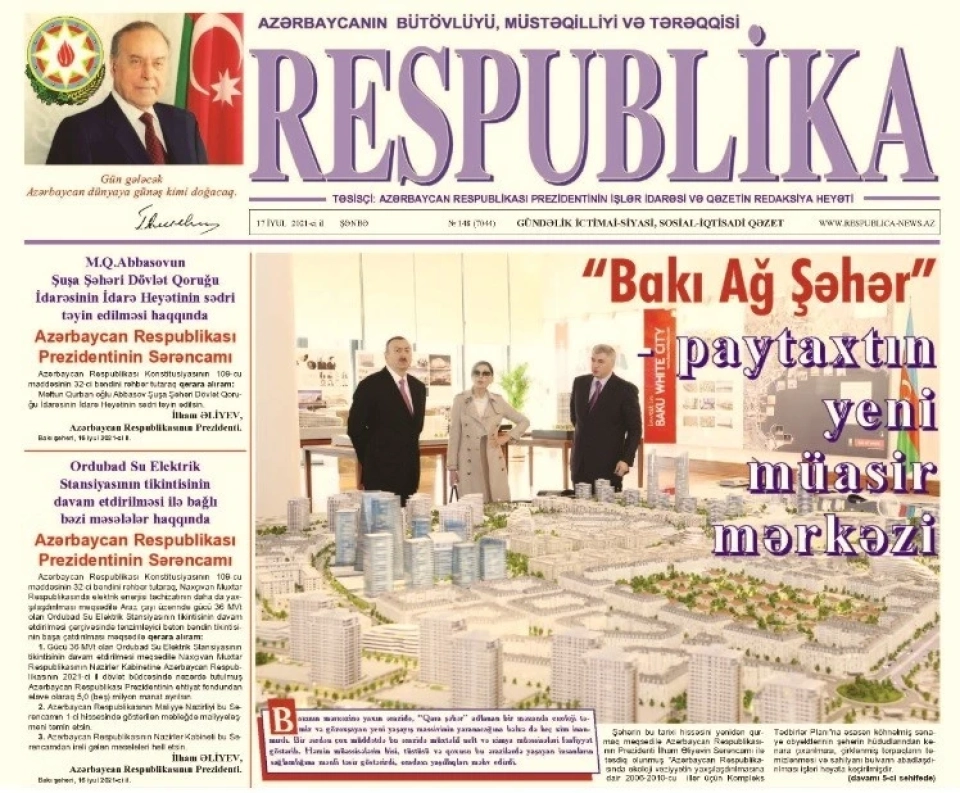
Perhaps few could have imagined that an environmentally clean and attractive new residential district would emerge near the centre of Baku in an area known as Black City. For more than a century, various oil and chemical enterprises operated here. Their soot, smoke and odours adversely affected the health of local residents and destroyed the surrounding greenery.
To redevelop this historic part of the city, obsolete industrial facilities were relocated beyond the city limits, contaminated land was cleaned up and the waterfront boulevard was landscaped under the “Comprehensive Action Plan for Improving the Environmental Situation in the Republic of Azerbaijan for 2006–2010,” approved by an Order of President of the Republic of Azerbaijan Ilham Aliyev.
Thinking of the bright future of Azerbaijan and its people, National Leader Heydar Aliyev spoke about Black City with his characteristic foresight: “The place that has been known as Black City in Azerbaijan for hundreds of years will become white and clean, flowers will be planted here, and it will turn into a beautiful corner of Azerbaijan.” This aspiration of the National Leader has now become a reality.
On December 24, 2011, President Ilham Aliyev laid the foundation for Baku White City, one of the largest and most ambitious urban development projects in the modern world.
Speaking about White City, the head of state said: “Some people have now forgotten that we used to close the windows when passing through that area, because the smoke and smell were unbearable. We have transformed Black City into White City. I believe this is one of the largest urban development projects in the world, meeting the highest standards. Apartment buildings are already being constructed there, and public spaces are being created. Replacing Black City with an environmentally clean city is another of our historic achievements.”
A legacy of the first oil boom and the urban planning measures of the distant past, Black City emerged in the eastern part of Baku in the late 19th century. It subsequently played an important role in the oil industry for more than a hundred years, serving as a centre for processing, storing and transporting “black gold.” However, while contributing to the economy and the development of the oil industry, Black City also damaged the capital’s environment. The soil became contaminated with oil, while the haphazard placement of industrial facilities and the absence of a sewerage system resulted in sewage and industrial waste being discharged directly into the Caspian Sea, alongside other harmful consequences.
The Baku White City master plan envisages the creation of ten mixed-use urban neighbourhoods. Each is planned to provide the best possible conditions for residents to live, work, relax and enjoy leisure activities. The project provides for the regeneration and development of the eastern part of the city centre — Black City — covering 1,650 hectares, and its transformation into Baku’s new modern residential centre.
Improving the environmental situation is among the country’s priorities. At a conference dedicated to the results of the first year of implementation of the “State Programme for the Socio-Economic Development of the Regions of the Republic of Azerbaijan for 2019–2023,” President Ilham Aliyev mentioned Baku White City among the measures taken to improve the country’s environment: “Black City was a major source of air and environmental pollution. White City now stands in its place. This is also a major urban development project. In the near future, relocating the oil refinery from that area will both extend the boulevard and further improve environmental conditions at the refinery.”
The project will deliver a total floor area of 15 million square metres. This represents approximately 120,000 residential and service units and 240,000 jobs.
British engineering and architectural design company Atkins serves as the lead consultant for Baku White City. Alongside Azerbaijani specialists, the renowned architectural practice Foster + Partners, founded by the legendary Norman Foster, architecture and engineering practice UNStudio and other prominent companies have been involved in the project.
Environmental considerations have been incorporated into every infrastructure project here. Measures have been implemented to maintain ecological balance throughout subsequent operations, particularly through the creation of green spaces and parks and projects that enhance the area’s environmental and aesthetic qualities.
The project envisages 350 hectares of landscaping. Baku White City also makes it possible to extend the existing boulevard by a further ten kilometres, turning it into the longest boulevard in the world. Plane trees, olive trees, palms, pines, cypresses and numerous other trees have been planted in the green leisure areas and parks. An area once regarded as a blight on Baku is now being transformed into an environmentally clean and attractive urban district.
Green Island, known as a residential neighbourhood, consists of seven-storey buildings in the Parisian style. Twenty-storey buildings have been constructed in the Park District, which covers a total area of 24 hectares. Arranged in an amphitheatre-like configuration in keeping with the terrain, the Park District offers beautiful views of the Seaside Boulevard and National Flag Square.
During the construction of new roads, soil contaminated with fuel oil and unsuitable industrially affected ground was excavated to a depth of up to two metres and removed from the site. Suitable quarry materials were then used to construct the road foundations. Work continued on 63 roads within Baku White City, with a combined length of 22.4 kilometres, widths ranging from 16 to 47 metres, and two, four or six traffic lanes. Along 1st Fountain, 1st Green Island, 2nd Green Island, 6th Park and Central East streets, with a combined length of 1,420 metres, 550,000 cubic metres of earthworks were carried out, 36,000 square metres of asphalt concrete were laid, 400,000 cubic metres of quarry materials were used in construction, and 22,000 square metres of pavements were built. Street lighting was installed, and various types of trees were planted along the roads.
Underground infrastructure was installed in accordance with the project, including sewage and stormwater collectors, electricity lines, gas supply pipes and IT duct systems. A retaining wall was built along the 90-metre section connecting the street serving the seven-storey buildings to Nobel Avenue. Information boards about the White City project and the history of Black City, a street clock, a thermometer and a commemorative medallion were installed in the park. A sculpture presented during the third international sculpture symposium, “Music in Stone,” organised by the Heydar Aliyev Foundation in September 2018, was also installed here.
The planned installed electrical capacity of the White City project is 250 megawatts, and the project envisages the construction of 46 substations at 110 kV and 35 kV. For the first time in Azerbaijan, automatic systems were installed at the White City-2 substation to isolate transformer fires and suppress them immediately. Special cable passages between floors and a cable basement with emergency access points were constructed, and a dedicated dispatch centre was established. The substation was equipped with electronic relay protection and automation systems, connected by fibre-optic cable and integrated into a remotely operated SCADA supervisory control system. A 110 kV double-circuit cable line was laid from the White City-1 substation to supply White City-2. Indoor switchgear of this type has a service life three times longer than outdoor equipment, is safe to operate and can be integrated into an advanced power network.
The White City-2 substation will supply electricity to 75,000 residential customers. It will also serve newly built social facilities, entertainment complexes, White City Boulevard, planned construction projects and residential complexes in the area. In addition to White City-2, seven 35/10/0.4 kV substations have been built within the Baku White City project.
On December 24, 2018, President of the Republic of Azerbaijan Ilham Aliyev and First Lady Mehriban Aliyeva attended the opening of the 110 kV White City-2 and Bakikhanov substations and 1st Fountain Street, as well as the groundbreaking ceremonies for the White City pedestrian bridge and Time Square. They also toured the completed Fountain Square Park.
Respecting Black City’s historical heritage, the project has restored kerosene-refining installations that were among the world’s most advanced in the 19th century, a retaining wall surrounding oil tanks dating from the late 19th and early 20th centuries, and a pavilion that supplied clean drinking water to residents between 1890 and 1940. The 19th-century retaining walls surrounding the oil storage facilities have also been preserved, and a pedestrian passage to the Olympic neighbourhood has been created along the wall. A series of stairways providing access to the park has been built within the newly landscaped green strip, and a granite commemorative stone bearing information about the project’s history and key figures has been installed.
Modern infrastructure creates opportunities both for people’s comfort and for attracting investment. People are a central consideration in implementing the White City project, which reflects contemporary global urban planning trends and stands out for its comprehensive approach.
The scale of the project and the professionalism of the work carried out ensure that Baku’s contemporary urban development is aligned with the latest trends, placing Baku White City among the world’s leading modern urban development projects. Through its implementation, Black City’s industrial character will become a thing of the past, giving way to a place of harmony and comfort called Baku White City. With its distinctive features, it will become a new modern centre of Baku, a leading city in the region.
Kamil ISMAYILOV
“Respublika”
Gallery